



The Benefits of a Private Mortgage
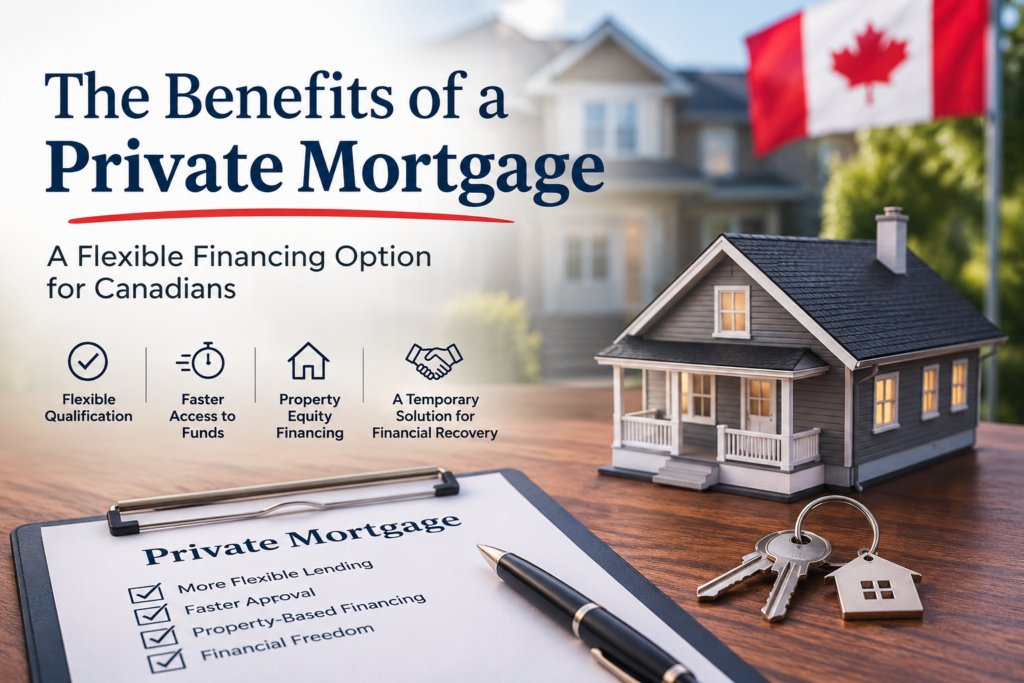
Getting approved for a mortgage through a traditional bank or credit union is not always straightforward. Lenders generally look closely at income, credit history, debt levels, employment, down payment, and the property itself before deciding whether to approve an application. For borrowers who do not fit conventional lending requirements, a private mortgage in Canada can provide another way to access financing. A private mortgage is typically offered by a private individual, mortgage investment corporation, syndicate, or other private lending source rather than a traditional financial institution. These lenders may assess an application differently and place greater emphasis on the value of the property and the overall circumstances of the transaction. Private mortgage financing is not the right solution for everyone. It can come with higher costs and shorter terms than a conventional mortgage, so borrowers should understand both the advantages and the risks before making a decision. When used for the right situation and supported by a clear repayment or refinancing plan, however, a private mortgage can provide valuable financial flexibility. What Is a Private Mortgage? A private mortgage is a loan secured against real estate and provided by a private lender rather than a traditional bank or credit union. The lender may be an individual, a mortgage investment corporation, a group of investors, or another private lending entity. The mortgage is registered against the property, just as other types of mortgages are, and the borrower agrees to repay the amount according to the terms of the mortgage. One important difference is how the application is assessed. Traditional lenders generally rely heavily on income verification, credit history, debt-service calculations, and established lending policies. Private lenders may place greater weight on the property’s value, available equity, the loan-to-value ratio, and the borrower’s overall plan for repaying the private mortgage. This flexibility can make private financing useful when a borrower needs a solution that does not fit the requirements of conventional lending. However, flexibility should not be confused with affordability. Private mortgages can have higher interest rates, fees, and other costs, which means the overall cost of borrowing needs to be considered carefully. Why Do Canadians Consider Private Mortgage Financing? There are several reasons a borrower may consider a private mortgage. A person may have strong equity in a property but be unable to qualify for traditional financing because of a recent credit problem, irregular income, self-employment, or another financial circumstance. In other cases, the borrower may need financing within a short timeframe and cannot complete the traditional mortgage approval process quickly enough. Private lending can also be considered by property owners who need temporary financing while they work toward a longer-term solution. For example, someone may use private financing to address an immediate financial requirement and then plan to refinance with a traditional lender once their financial position improves. The reason for choosing a private mortgage matters. Before proceeding, borrowers should understand exactly what the financing is intended to accomplish and how they expect to repay or replace the private mortgage when the term ends. Key Benefits of a Private Mortgage More Flexible Qualification Requirements One of the main benefits of a private mortgage is greater flexibility in the approval process. Private lenders may consider factors that do not fit neatly within the lending rules used by traditional financial institutions. This can be particularly helpful for borrowers whose income, credit history, or financial circumstances make conventional mortgage approval difficult. For example, a self-employed borrower may have fluctuating income or tax deductions that affect how their income appears on paper. Someone recovering from a recent credit problem may also have difficulty meeting a bank’s requirements despite owning a property with significant equity. A private lender may assess the complete situation differently. This does not mean that approval is guaranteed or that financial information is unimportant. The lender still needs to understand the transaction and assess the security offered by the property. The difference is that the lending decision may be based on a broader set of circumstances. Faster Access to Mortgage Financing Timing can be another reason borrowers consider private mortgage financing. Traditional mortgage applications can require extensive documentation and may take time to process, particularly when the borrower’s financial situation is complex. Private lenders may be able to evaluate certain applications more quickly when the transaction is straightforward and the required information is available. This can be valuable when a borrower is dealing with a time-sensitive real estate transaction. It may also help someone who needs to address an urgent financial obligation secured against their property. Speed, however, should never be the only reason to accept a private mortgage. A quick approval does not necessarily mean the financing is suitable. The borrower should understand the interest rate, fees, term, payment structure, renewal conditions, and repayment strategy before accepting the mortgage. Financing Based on Property Equity Property equity can be an important consideration in private mortgage lending. If a homeowner has built substantial equity in their property, that equity may provide security for a private lender even when the borrower does not meet the requirements of a traditional lender. This can be particularly relevant for homeowners who need access to capital but have temporary financial difficulties. The property may have considerable value even though the borrower’s current income or credit profile does not meet a bank’s criteria. The amount that can be borrowed will depend on factors such as the property’s value, the existing mortgage, the proposed loan amount, and the lender’s requirements. A professional assessment is necessary to determine whether the available equity can support the requested financing. A Temporary Solution During Financial Recovery For some borrowers, a private mortgage is best viewed as a temporary financial bridge rather than a long-term mortgage. The goal may be to use the private financing while taking steps to improve credit, stabilize income, reduce debt, or resolve another issue that prevented traditional financing. For example, a homeowner may use a private mortgage after a financial setback and work toward qualifying for a conventional
Remortgage and Save Money
If you are like most homeowners, you know how important it can be to save money when you can. One strategy you may not have considered for saving money is to remortgage your home. Remortgage – or refinancing – can save you money in several ways which we will discuss in this blog.
One should know what are the do’s and dont’s when purchasing a home
Are you in the market for a new home? Congratulations! Here are a few dos and don’ts to help make your experience a good one: Do get preapproved for a loan. This will give you an idea of what you can afford so that you won’t waste a lot of time looking at homes that are out of your budget. Additionally, it is important because many real estate agents won’t work with a client until they have been preapproved for a loan. Don’t make a large purchase on credit before your closing date. Even if you have been preapproved for a loan, the lender can still change their mind if your financial situation changes. Major purchases such as a new vehicle can jeopardize your mortgage application.
Buying A Home? Tools and Resources for Homebuyers

Buying a home is a major financial decision, and having the right information before you start can make the process much easier. From figuring out what you can afford to saving for a down payment, comparing mortgage options and planning for closing costs, there are several decisions to make before you receive the keys. Fortunately, Canadian homebuyers have access to a range of government tools, calculators, savings programs and professional resources that can help at different stages of the process. Using these resources early can give you a clearer idea of your budget and help you avoid costly surprises. The Financial Consumer Agency of Canada provides several free resources for homebuyers, including a mortgage calculator, mortgage qualifier tool, budget planner and financial goal calculator. These tools can help you understand your finances before you begin making offers on properties. This guide brings some of the most useful homebuyer tools and resources in Canada together in one place, while explaining when and how to use them. Start With a Home Buying Budget Calculator Before looking at homes, determine how much you can realistically spend. It is easy to focus on the maximum mortgage a lender might approve, but your personal budget should be the starting point for deciding what you can comfortably afford. A budget should include more than your expected mortgage payment. Consider property taxes, home insurance, utilities, maintenance, transportation, groceries, childcare and other regular expenses. You should also leave room for unexpected costs because owning a home can bring expenses that do not appear in a basic mortgage calculation. The purpose of a home buying budget is to establish a comfortable range rather than simply finding the highest possible purchase price. Use a Mortgage Payment Calculator A mortgage payment calculator is one of the most useful tools for Canadian homebuyers. It can help you estimate your regular mortgage payments based on factors such as the mortgage amount, interest rate, amortization period and payment frequency. Try different scenarios rather than entering only one set of numbers. For example, compare the payment on a $500,000 mortgage with different interest rates and amortization periods. You can also see how a larger down payment could affect the amount you need to borrow. Remember that an online calculator provides an estimate. Your actual mortgage payment will depend on the mortgage product, interest rate and terms offered by the lender. Try a Mortgage Qualifier Tool Knowing what you can afford and knowing what you may qualify for are two different things. A mortgage qualifier tool can help you estimate whether your income, expenses and proposed purchase price may fit within common mortgage qualification requirements. Mortgage Qualifier Tool allows potential buyers to enter information about the property, income and expenses to get an estimate of their potential qualification. This can be useful before speaking with a mortgage professional because it gives you an initial understanding of your borrowing position. However, the result should not be treated as a mortgage approval or a guarantee that a lender will provide financing. A lender will review your financial information and may consider factors such as your credit history, income, existing debts, down payment and the property you want to purchase. Understand Canada’s Mortgage Stress Test Canadian homebuyers should also understand the mortgage stress test before setting a purchase budget. The qualifying rate is designed to assess whether borrowers could continue making mortgage payments if interest rates rise. For federally regulated lenders, the minimum qualifying rate for uninsured mortgages has been set as the greater of the mortgage contract rate plus 2 percentage points or 5.25 percent. This means that the mortgage amount you qualify for may be lower than the amount suggested by a basic mortgage payment calculation. The stress test is one reason it is important to speak with a mortgage professional before making assumptions about your maximum borrowing capacity. Knowing about the qualifying rate early can help you search for homes within a more realistic price range. Use a First Home Savings Account If you are an eligible first-time homebuyer in Canada, a First Home Savings Account (FHSA) can be an important resource for building your down payment. The FHSA allows eligible individuals to save for a qualifying first home with tax advantages. The annual participation limit is $8,000, and the lifetime limit is $40,000. Contributions are generally deductible, while qualifying withdrawals used to purchase or build a qualifying home can be made without tax. There are eligibility requirements, so not everyone who is planning to buy a home can automatically open an FHSA. The Canada Revenue Agency explains that the first-time homebuyer rules generally consider whether you lived in a home that you or your spouse or common-law partner owned during the current year or previous four calendar years. If you are saving for your first home, it is worth understanding the FHSA rules early rather than waiting until you are ready to make an offer. Learn About the Home Buyers’ Plan Another important resource for eligible Canadian homebuyers is the Home Buyers’ Plan (HBP). It allows eligible individuals to withdraw money from their Registered Retirement Savings Plan to buy or build a qualifying home. The current withdrawal limit under the HBP is $60,000. The Canada Revenue Agency also confirms that eligible buyers can use the HBP and make a qualifying FHSA withdrawal for the same home, provided they meet the conditions for both programs. Using retirement savings for a home purchase is a significant decision, so understand the repayment rules before making a withdrawal. The HBP is not simply a tax-free withdrawal that never needs to be addressed. If you are considering using both your FHSA and RRSP, review the rules carefully and consider speaking with a qualified financial professional about how the decision fits into your broader financial plan. Research the Home Buyers’ Amount The Home Buyers’ Amount is another federal tax measure that eligible first-time homebuyers and certain persons with disabilities may be able to claim. The Canada Revenue Agency currently identifies
How Mortgage Brokers Can Help Reduce the Financial Stress

Retirement can bring a welcome change in pace, but it can also change the way a household needs to manage its money. A mortgage payment that was comfortable while you were working can feel very different when employment income is replaced by pension income, government benefits or investment withdrawals. At the same time, property taxes, home insurance, utilities, repairs and everyday living expenses continue. For some retired Canadians, the problem is not a lack of wealth. It is that much of their wealth is tied up in their home. A homeowner may have substantial equity but limited monthly income available to cover expenses. This can create financial stress even when the person owns a valuable property. A mortgage broker can help by looking at the entire financial picture and explaining available borrowing options. The purpose is not to encourage retirees to take on unnecessary debt. It is to determine whether refinancing, a home equity solution, mortgage renewal or another option could make their finances easier to manage while they remain in their home. According to Statistics Canada, households with a major income earner aged 55 to 64 experienced an increase in mortgage debt in recent years. This highlights an important reality for Canadians approaching retirement: mortgage planning does not necessarily end when employment does. Why Mortgage Debt Can Feel Different During Retirement During your working years, mortgage payments are usually supported by employment income. Once you retire, your income may come from several sources, including the Canada Pension Plan, Old Age Security, workplace pensions, registered retirement income and investments. These income sources can provide stability, but they may not give you the same flexibility you had while working. You may also want to preserve your savings for healthcare, travel, family support or unexpected expenses. A large mortgage payment can therefore take up a greater portion of your available monthly income. This is where reviewing your mortgage can be worthwhile. Instead of waiting until payments become difficult, you can examine your options while your financial position is still manageable. What Can a Mortgage Broker Do for a Retired Homeowner? A mortgage broker can review your current mortgage, income, debts, property value and available equity before discussing potential solutions. This provides a more complete picture than simply looking at the mortgage balance. The right option will depend on what you are trying to accomplish. One homeowner may want to reduce monthly payments, while another may need funds for home repairs or want to consolidate high-interest debt. Someone else may be approaching mortgage renewal and want to know whether another lender could offer more suitable terms. AKAL Mortgages Inc. works with a network of lenders and provides mortgage solutions based on individual financial circumstances. The company’s website notes that its mortgage professionals compare mortgage options from major banks and other lenders rather than limiting clients to one institution. For a retiree, that broader approach can be useful because retirement income and financial circumstances can differ considerably from those of a typical employed borrower. Start With Your Monthly Retirement Budget Before considering any new mortgage or home equity product, take a close look at your monthly budget. This should include all regular income and expenses rather than focusing only on the mortgage payment. Consider property taxes, home insurance, utilities, groceries, transportation, healthcare, home maintenance and other recurring costs. You should also leave room for unexpected expenses because home repairs and other financial needs do not always arrive at convenient times. Once you understand your monthly cash flow, you can determine whether the current mortgage is genuinely creating pressure. This also helps a mortgage professional understand what type of solution may be appropriate. The objective should be to create a mortgage arrangement that works with your retirement income rather than forcing your retirement budget to work around an unsuitable mortgage. Mortgage Renewal Can Be an Opportunity to Reassess A mortgage renewal is an important point at which retirees can review their financial position. Many homeowners simply renew with their existing lender because the process appears easier, but you are not required to automatically accept the renewal terms. Your financial needs may also be very different from when you first arranged the mortgage. You may now have less employment income, more home equity or a stronger preference for predictable payments. A mortgage broker can compare the available options and help you understand whether renewing, switching lenders or restructuring your mortgage makes sense. Could Refinancing Reduce Financial Pressure? Mortgage refinancing may be considered when a homeowner wants to replace their existing mortgage with a new arrangement. Depending on the circumstances, refinancing can potentially provide access to home equity or allow several debts to be combined. For example, a retiree may have a mortgage as well as credit card balances or personal loans carrying higher interest rates. Consolidating eligible debts into mortgage financing may simplify the number of monthly payments and potentially reduce the overall interest cost. However, refinancing should never be viewed as a simple way to make debt disappear. The debt still has to be repaid, and moving other debts onto a mortgage means the borrowing becomes secured against the home. A careful comparison is therefore essential. The homeowner needs to understand the new mortgage payment, interest cost, fees and long-term effect on home equity before making a decision. Using Home Equity Without Selling Your Home For many retired Canadians, home equity is their largest financial asset. If you have owned your home for many years and paid down a substantial portion of your mortgage, you may have significant equity available. Home equity is essentially the difference between your home’s current value and the amount you still owe against it. A homeowner may potentially access some of this equity through refinancing, a home equity line of credit, a second mortgage or, depending on eligibility, a reverse mortgage. The important question is not simply how much equity you have. It is whether accessing that equity will solve a genuine financial need without creating a larger problem
How to Choose the Right Mortgage Lender in Canada

Choosing a mortgage lender is one of the most important financial decisions you will make when buying a home in Canada. The lender you choose can affect your interest rate, monthly payments, mortgage features, penalties and the overall cost of borrowing. Yet many home buyers focus almost entirely on the rate and overlook the details that can matter just as much over the life of the mortgage. The lowest advertised mortgage rate is not always the best mortgage for your situation. A mortgage with a slightly lower rate may have restrictions that make it expensive to break, while another option with a slightly higher rate could offer better prepayment privileges or greater flexibility. The right choice depends on how you expect to use your mortgage, not simply on the number attached to the interest rate. The good news is that Canadian home buyers have several options. You can approach a bank, credit union, mortgage company or mortgage broker, compare the available products and choose the option that best fits your financial circumstances. The Financial Consumer Agency of Canada recommends shopping around because different lenders can offer different rates and conditions for similar mortgage products. What Is a Mortgage Lender in Canada? A mortgage lender is a financial institution or company that provides the money you borrow to purchase a home. In Canada, mortgage lenders can include banks, credit unions, mortgage companies, insurance companies, trust companies and other lending organizations. Each lender can have its own products, rates, qualification requirements and mortgage terms. A mortgage broker works differently. A broker does not normally lend you the money directly. Instead, the broker works with lenders and helps borrowers compare mortgage options based on their financial circumstances. Because brokers can have access to multiple lenders, they may be able to provide a wider range of options than a borrower would find by approaching only one financial institution. However, not every mortgage broker works with the same lenders, so it is reasonable to ask which lenders they can access. Understanding this difference can make your mortgage search much easier. Rather than asking only, “Which bank has the lowest rate?”, consider asking, “Which mortgage lender and mortgage product are the best fit for my financial situation?” Start by Understanding Your Own Financial Situation Before comparing mortgage lenders, establish a clear picture of what you can comfortably afford. The maximum amount a lender is willing to approve is not necessarily the amount you should borrow. Your monthly budget needs to leave enough room for property taxes, home insurance, utilities, maintenance, unexpected expenses and changes in your household finances. Review your income, existing debts, credit history, savings and planned down payment. If you are self-employed, recently changed jobs, have variable income or have other financial circumstances that may require additional consideration, identify those factors before you start comparing lenders. Your financial position will influence the type of mortgage lender that may be suitable for you. A borrower with strong credit, stable employment and a substantial down payment may have many choices, while someone with a more complex financial situation may benefit from working with a lender that takes a broader approach to mortgage applications. Compare More Than Mortgage Rates Interest rate is important, but it should not be the only factor you use to choose a mortgage lender. A difference in rate can affect your payments and total interest cost, but the terms attached to that rate can also have a significant financial impact. The Financial Consumer Agency of Canada notes that mortgage rates can depend on factors such as the mortgage term, type of interest rate, credit history, employment situation, lender and whether you qualify for a discounted rate. It also recommends shopping around because negotiating or comparing rates can potentially save borrowers thousands of dollars. When comparing two mortgage offers, look at the complete package. Consider the interest rate, term, payment options, prepayment privileges, penalties, fees, portability and other conditions before deciding which lender offers the better deal. A mortgage with the lowest rate on paper may not be the best option if its restrictions do not fit your plans. Look at the Mortgage Term and Interest Rate The mortgage term is the period during which your mortgage contract remains in effect. In Canada, terms can range from a few months to five years or longer, although many Canadian borrowers choose shorter terms. When the term ends, you generally need to renew the mortgage or pay the outstanding balance in full. You will also need to decide whether a fixed or variable interest rate is appropriate for your circumstances. A fixed-rate mortgage provides a set interest rate during the term, while a variable-rate mortgage can change as the lender’s prime rate changes. Neither option is automatically better for every borrower. A fixed rate may appeal to someone who values predictable payments, while a borrower who is comfortable with changes in payments may consider a variable option. Your income stability, budget, risk tolerance and expectations for the mortgage should all be part of the conversation. Understand Mortgage Fees Before Signing The interest rate is only one part of the cost of a mortgage. Depending on the lender and mortgage product, you may encounter fees associated with the mortgage application, appraisal, legal work, discharge, registration or other services. Ask the lender or mortgage broker to explain all costs before you commit. If a lender is offering a cash-back mortgage or another incentive, understand what you are receiving and whether there are conditions attached to it. You should also pay close attention to the costs of breaking the mortgage before the end of the term. The Financial Consumer Agency of Canada notes that borrowers may face a prepayment penalty and other charges when breaking a mortgage contract, depending on the circumstances and the terms of the mortgage. A lower rate today may not save you money if you later have to pay a substantial penalty to sell your home, refinance or switch lenders. Pay Close Attention to
Do you know how the mortgage rates are determined?
As mortgage brokers, one of the most commonly asked questions we hear is about how mortgage rates are determined. Obviously, you are going to see B and C lenders having higher rates than traditional or “A” lenders simply because the loans made by alternative lenders are usually considered higher risk. But where do the A lenders get their rates?
Want to Know How To Fix a Bad Credit Score? Read Our Top Tips!

A bad credit score can make borrowing more difficult and expensive. Whether you are planning to buy a home, refinance an existing mortgage, apply for a personal loan or simply want greater financial flexibility, your credit history can influence the options available to you. The good news is that a low credit score does not have to remain that way forever. Improving your credit score is usually a gradual process rather than something that happens after one payment or one financial decision. The most effective approach is to understand what is hurting your credit, make your payments consistently, manage your available credit carefully and give your credit history time to improve. If you are asking, “How can I fix my bad credit score?”, the answer starts with your current credit report. Once you understand what lenders see when they review your credit history, you can take practical steps to address the problems and establish stronger financial habits. What Is Considered a Bad Credit Score in Canada? Credit scores in Canada generally range from 300 to 900, although the way lenders interpret a score can vary depending on the type of credit you are applying for and the lender’s own requirements. A lower score can indicate a greater level of risk to a lender, while a stronger score can make it easier to qualify for credit and potentially receive more favourable interest rates. Your credit score is based on information contained in your credit report. There is no single number that determines whether someone will qualify for a mortgage or other form of credit. A lender may also consider your income, employment, existing debts, payment history, down payment and overall financial situation. This is particularly important when you are trying to improve your credit because a low score is only one part of your financial picture. Instead of focusing entirely on reaching a particular score, concentrate on improving the factors that influence your credit profile. Consistent financial behaviour over time can create a much stronger foundation for future borrowing. Start by Checking Your Credit Report One of the first steps to fixing a bad credit score is finding out exactly what is being reported about you. You can request your credit reports from Canada’s two main credit bureaus, Equifax and TransUnion, without paying for a basic report. Checking your own credit report does not lower your credit score. Review both reports carefully because the information may not be identical. Look for accounts that you do not recognize, incorrect personal information, payments incorrectly reported as late, balances that appear wrong and negative information that should no longer be on the report. This step is particularly important if your credit score has fallen unexpectedly. An error on your credit report can make it harder to obtain credit and may result in higher interest rates. The Financial Consumer Agency of Canada recommends checking your reports regularly and contacting the credit bureau to dispute information that is inaccurate. What If You Find an Error? Do not ignore an inaccurate entry simply because you think it is too small to matter. Gather statements, receipts, payment confirmations or other documents that support your position, and contact the credit bureau to dispute the incorrect information. Credit bureaus must correct errors for free when an investigation confirms that the information is inaccurate. If the problem relates to an account with a lender, you should also contact the lender directly so that the source of the information can review its records. Correcting an error may not instantly transform your credit score, but removing inaccurate negative information can prevent you from being assessed based on information that does not reflect your actual financial behaviour. Make Every Payment on Time Your payment history is one of the most important parts of your credit score. A pattern of missed or late payments can make lenders question whether you will make future payments as agreed. The Financial Consumer Agency of Canada recommends making payments on time and, if you cannot pay the entire amount, making at least the required minimum payment. Set up automatic payments where appropriate, particularly for bills that have predictable monthly amounts. You can also use alerts from your bank or financial institution to remind you when payments are due. These simple systems can help prevent an otherwise avoidable late payment. If you are already behind on a payment, do not wait for the situation to become worse. Contact the lender and explain your circumstances as soon as possible. Depending on your situation, the lender may be able to discuss alternative payment arrangements or other options. Reduce Your Credit Card Balances Carrying a large balance compared with your available credit can work against you even if you make your payments on time. This is known as your credit utilization, which compares the amount of credit you are using with the credit available to you. The Financial Consumer Agency of Canada recommends trying to keep credit use below 30 percent of your available limit. For example, if your credit card has a $10,000 limit, keeping the balance below approximately $3,000 is one practical target. Reducing your balances can therefore be an important part of rebuilding credit. If you have several credit cards with high balances, look at your overall debt rather than concentrating on just one account. Paying down the balances can also reduce interest costs, giving you more room in your monthly budget to address other debts. Do Not Close Every Credit Account You Have When people begin fixing their credit, they sometimes assume that closing credit cards is the best way to avoid debt. That may not always be the right approach. An older account can contribute to the length and stability of your credit history. Closing an older account can also reduce your total available credit, which could increase your credit utilization if you continue carrying balances on other accounts. The Financial Consumer Agency of Canada suggests considering whether an older account can remain open when it has
7 Tips for First-Time Homebuyers to Get a Mortgage
Are you in a position to start looking for a home? If you are be sure to read our seven tips for first-time homebuyers looking for a mortgage first!
Simple Guidance for a Small Business Mortgage
A small business mortgage is a commercial loan that is used to purchase commercial property. While many small business owners lease their office space, some find it more beneficial to buy it outright. And unless you are sitting on a pile of cash, there is a good chance that you are going to need a small business mortgage in order to do that. To get a small business mortgage, you will typically need a higher down payment than you would for a residential mortgage. This can be as high as 35-50%. Fortunately, the bigger the commercial loan, the lower the interest rates usually are on the mortgage.