



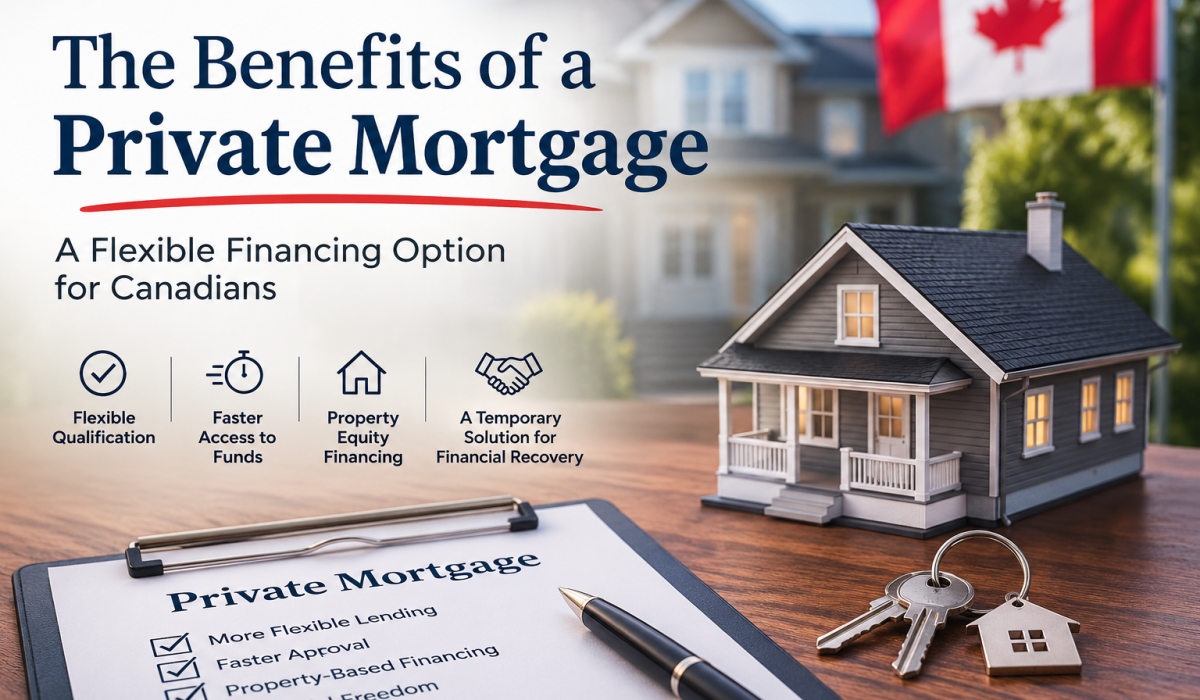
Getting approved for a mortgage through a traditional bank or credit union is not always straightforward. Lenders generally look closely at income, credit history, debt levels, employment, down payment, and the property itself before deciding whether to approve an application. For borrowers who do not fit conventional lending requirements, a private mortgage in Canada can provide another way to access financing.
A private mortgage is typically offered by a private individual, mortgage investment corporation, syndicate, or other private lending source rather than a traditional financial institution. These lenders may assess an application differently and place greater emphasis on the value of the property and the overall circumstances of the transaction.
Private mortgage financing is not the right solution for everyone. It can come with higher costs and shorter terms than a conventional mortgage, so borrowers should understand both the advantages and the risks before making a decision. When used for the right situation and supported by a clear repayment or refinancing plan, however, a private mortgage can provide valuable financial flexibility.
What Is a Private Mortgage?
A private mortgage is a loan secured against real estate and provided by a private lender rather than a traditional bank or credit union. The lender may be an individual, a mortgage investment corporation, a group of investors, or another private lending entity. The mortgage is registered against the property, just as other types of mortgages are, and the borrower agrees to repay the amount according to the terms of the mortgage.
One important difference is how the application is assessed. Traditional lenders generally rely heavily on income verification, credit history, debt-service calculations, and established lending policies. Private lenders may place greater weight on the property’s value, available equity, the loan-to-value ratio, and the borrower’s overall plan for repaying the private mortgage.
This flexibility can make private financing useful when a borrower needs a solution that does not fit the requirements of conventional lending. However, flexibility should not be confused with affordability. Private mortgages can have higher interest rates, fees, and other costs, which means the overall cost of borrowing needs to be considered carefully.
Why Do Canadians Consider Private Mortgage Financing?
There are several reasons a borrower may consider a private mortgage. A person may have strong equity in a property but be unable to qualify for traditional financing because of a recent credit problem, irregular income, self-employment, or another financial circumstance. In other cases, the borrower may need financing within a short timeframe and cannot complete the traditional mortgage approval process quickly enough.
Private lending can also be considered by property owners who need temporary financing while they work toward a longer-term solution. For example, someone may use private financing to address an immediate financial requirement and then plan to refinance with a traditional lender once their financial position improves.
The reason for choosing a private mortgage matters. Before proceeding, borrowers should understand exactly what the financing is intended to accomplish and how they expect to repay or replace the private mortgage when the term ends.
Key Benefits of a Private Mortgage
More Flexible Qualification Requirements
One of the main benefits of a private mortgage is greater flexibility in the approval process. Private lenders may consider factors that do not fit neatly within the lending rules used by traditional financial institutions. This can be particularly helpful for borrowers whose income, credit history, or financial circumstances make conventional mortgage approval difficult.
For example, a self-employed borrower may have fluctuating income or tax deductions that affect how their income appears on paper. Someone recovering from a recent credit problem may also have difficulty meeting a bank’s requirements despite owning a property with significant equity. A private lender may assess the complete situation differently.
This does not mean that approval is guaranteed or that financial information is unimportant. The lender still needs to understand the transaction and assess the security offered by the property. The difference is that the lending decision may be based on a broader set of circumstances.
Faster Access to Mortgage Financing
Timing can be another reason borrowers consider private mortgage financing. Traditional mortgage applications can require extensive documentation and may take time to process, particularly when the borrower’s financial situation is complex. Private lenders may be able to evaluate certain applications more quickly when the transaction is straightforward and the required information is available.
This can be valuable when a borrower is dealing with a time-sensitive real estate transaction. It may also help someone who needs to address an urgent financial obligation secured against their property.
Speed, however, should never be the only reason to accept a private mortgage. A quick approval does not necessarily mean the financing is suitable. The borrower should understand the interest rate, fees, term, payment structure, renewal conditions, and repayment strategy before accepting the mortgage.
Financing Based on Property Equity
Property equity can be an important consideration in private mortgage lending. If a homeowner has built substantial equity in their property, that equity may provide security for a private lender even when the borrower does not meet the requirements of a traditional lender.
This can be particularly relevant for homeowners who need access to capital but have temporary financial difficulties. The property may have considerable value even though the borrower’s current income or credit profile does not meet a bank’s criteria.
The amount that can be borrowed will depend on factors such as the property’s value, the existing mortgage, the proposed loan amount, and the lender’s requirements. A professional assessment is necessary to determine whether the available equity can support the requested financing.
A Temporary Solution During Financial Recovery
For some borrowers, a private mortgage is best viewed as a temporary financial bridge rather than a long-term mortgage. The goal may be to use the private financing while taking steps to improve credit, stabilize income, reduce debt, or resolve another issue that prevented traditional financing.
For example, a homeowner may use a private mortgage after a financial setback and work toward qualifying for a conventional mortgage later. Once the borrower’s circumstances improve, refinancing with a bank or another lower-cost lender may become possible.
This is why an exit strategy for a private mortgage is so important. FSRA has specifically highlighted the need for borrowers using higher-cost mortgage financing to have a plan for moving to lower-cost financing after the private mortgage term ends. (FSRA)
Private Mortgages Can Help in Several Situations
Private mortgage financing can be considered in different circumstances, depending on the borrower’s financial position and the property involved.
Self-Employed Borrowers
Self-employed Canadians may have difficulty qualifying for traditional financing when their income is complex or difficult to document using standard lending requirements. A private lender may take a different approach when evaluating the application.
This can provide a financing option while the borrower works toward meeting the requirements of a conventional lender. The long-term objective should still be to build a stronger financial profile and move to more affordable financing when appropriate.
Borrowers With Credit Challenges
A recent missed payment, consumer proposal, bankruptcy, or other credit issue can affect a person’s ability to obtain a traditional mortgage. Private financing may provide an opportunity to access mortgage funds while rebuilding credit.
However, borrowers should avoid using private financing without understanding how the mortgage fits into their broader financial plan. The higher cost of private borrowing can create additional pressure if there is no realistic path toward refinancing or repayment.
Real Estate Investors
Real estate investors sometimes require financing that does not fit conventional lending timelines or requirements. A private mortgage may provide short-term financing for a property purchase, renovation, or another investment strategy.
Investors should carefully calculate the expected costs and returns before accepting private financing. The projected value of the property or investment should not be the only consideration because interest, lender fees, legal costs, and other expenses can significantly affect the final outcome.
Borrowers Facing Time-Sensitive Transactions
A borrower may occasionally need financing within a limited timeframe because of a purchase closing, refinance deadline, or another property-related obligation. Private lenders can sometimes provide an alternative when conventional financing cannot be arranged within the required timeframe.
The borrower should still compare the private mortgage against all available alternatives. A financing solution that solves an immediate deadline but creates an unaffordable obligation later may not be a good financial decision.
Private Mortgage vs. Traditional Mortgage
The biggest difference between a private mortgage and a traditional mortgage is generally the way the borrower and transaction are assessed. Banks and other traditional lenders usually have established qualification requirements that consider income, credit history, debt levels, and other financial factors.
Private lenders may have more flexibility in assessing the application, particularly when there is substantial equity or a strong property-based security position. This can make private financing accessible to borrowers who may not qualify through conventional channels.
The trade-off is usually cost. Private mortgages may carry higher interest rates and additional fees, and the terms may be shorter. Borrowers should therefore compare the total cost of borrowing, rather than focusing only on whether the mortgage can be approved.
What Are the Risks of a Private Mortgage?
The benefits of private lending need to be considered alongside the risks. Private mortgage financing can be useful, but it is generally more expensive than conventional mortgage financing and may have shorter terms.
A borrower who focuses only on obtaining approval may overlook whether the payments are sustainable. It is important to calculate the full cost of the mortgage and understand what will happen when the term expires.
There is also a risk of relying on an uncertain future event to repay the mortgage. For example, a borrower may expect to refinance with a bank after improving their credit, selling another property, or increasing their income. If that event does not happen as expected, refinancing may become difficult.
How Much Does a Private Mortgage Cost?
There is no single private mortgage rate that applies to every borrower in Canada. The cost can vary depending on the property, loan amount, loan-to-value ratio, location, borrower circumstances, lender, mortgage term, and other factors.
In addition to interest, borrowers may encounter lender fees, brokerage fees, legal expenses, appraisal costs, and other transaction expenses. These costs should be reviewed before signing the mortgage documents so that the borrower understands the actual financial commitment.
What Should You Consider Before Getting a Private Mortgage?
Before accepting private mortgage financing, look beyond the approval itself. Ask how much the mortgage will cost over the full term and whether the payments fit comfortably within your budget. You should also understand what happens when the term ends and whether refinancing is likely to be available at that point.
It is also important to understand the property valuation and the amount of equity being used to secure the mortgage. Borrowing too much against a property can leave less flexibility if property values change or you need to refinance later.
Finally, make sure you understand the role of your mortgage professional. Borrowers should work with properly licensed mortgage professionals for regulated mortgage brokering activities.
How a Mortgage Broker Can Help With Private Mortgage Financing
Finding a private mortgage is not simply about locating a lender willing to approve an application. A mortgage broker can review your financial circumstances, understand why traditional financing may not be available, and help determine whether private lending is appropriate for your situation.
A broker can also help you compare available mortgage options and explain important details such as interest, fees, term length, repayment requirements, and renewal conditions. This can make it easier to compare the true cost of different financing options.
Most importantly, the conversation should include what happens after the private mortgage term ends. If the goal is to refinance into a traditional mortgage, your broker can help you identify the steps you may need to take to improve your position before that time.
Is a Private Mortgage Right for You?
A private mortgage can be a useful financing option when traditional mortgage lending does not meet your needs. It can provide greater flexibility, access to property-based financing, and a potential short-term solution for borrowers dealing with credit, income, timing, or other challenges.
At the same time, private financing is not automatically the better choice simply because it is easier to obtain. Higher borrowing costs and shorter terms mean that the mortgage needs to fit into a realistic financial plan. Understanding both the benefits and the risks is essential before making a decision.
If you are considering a private mortgage in Canada, AKAL Mortgages Inc can help you review your options and understand how private financing may fit into your financial goals. We can assess your situation, discuss available mortgage solutions, and help you determine whether private lending is an appropriate option for your circumstances.
Frequently Asked Questions About Private Mortgages
What is the main benefit of a private mortgage?
The main benefit is flexibility. A private mortgage may provide financing to borrowers who do not meet the qualification requirements of traditional lenders, particularly when there is sufficient equity in the property and a reasonable repayment plan.
Is a private mortgage more expensive than a bank mortgage?
Private mortgages can be more expensive than mortgages from traditional lenders. Borrowers should consider the interest rate as well as lender fees, brokerage fees, legal costs, and other expenses when comparing financing options.
Can I get a private mortgage with bad credit?
It may be possible to obtain private mortgage financing with credit challenges, depending on the property, available equity, loan amount, and overall circumstances. However, approval and terms vary between lenders, and borrowers should consider how they will eventually transition to more affordable financing.
How long does a private mortgage usually last?
Private mortgages are often structured as shorter-term financing arrangements, but the exact term depends on the lender and transaction. Before accepting the mortgage, borrowers should understand the maturity date and have a clear plan for repayment or refinancing.
Can a mortgage broker help me find a private lender?
Yes. A properly licensed mortgage broker can help borrowers understand private mortgage options and connect them with appropriate lenders.
Consider the Bigger Financial Picture
A private mortgage can provide an important financial option when conventional lending is not available or does not meet a borrower’s immediate needs. Its flexibility can help homeowners access property-based financing, manage time-sensitive situations, or create a temporary bridge while they work toward stronger financial circumstances.
The most important consideration is what the mortgage accomplishes and what happens next. A private mortgage should fit into a realistic plan that accounts for the total cost of borrowing and provides a practical way to repay or refinance the loan.
If you are exploring private mortgage options in Canada, contact AKAL Mortgages Inc. to discuss your circumstances and determine whether private mortgage financing is suitable for your needs.