



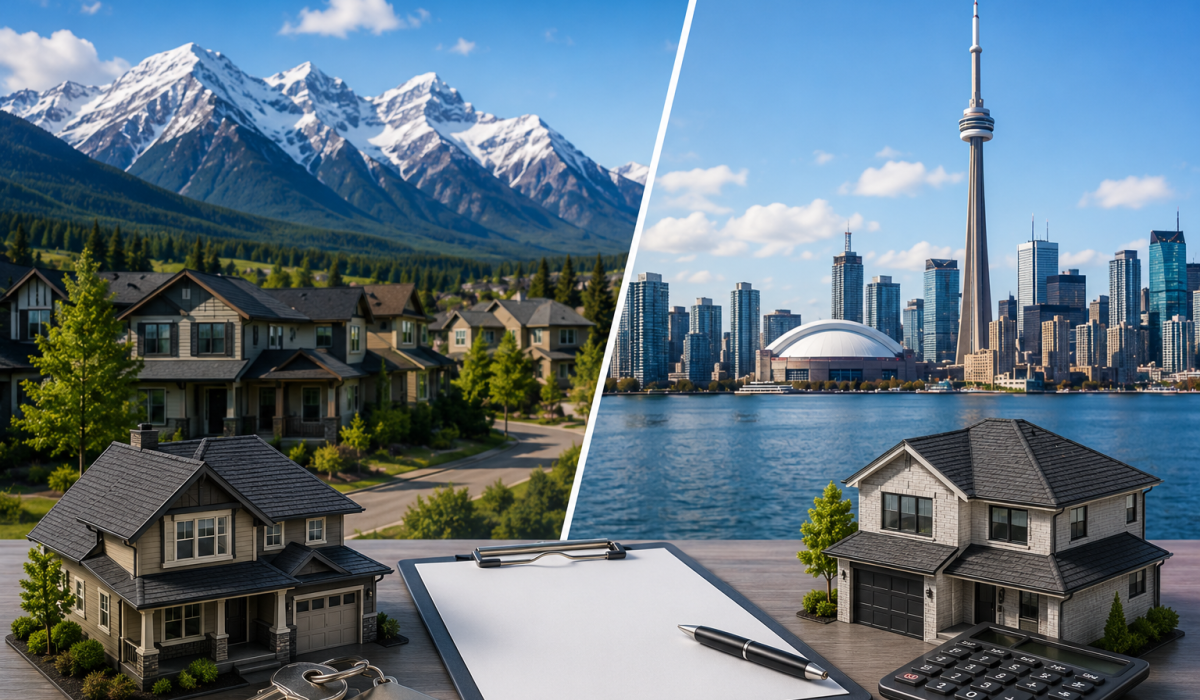
Mortgage qualification rules are the same across Canada, but Alberta has no provincial land transfer tax, which can save Ontario buyers thousands of dollars in closing costs. The core requirements, income, credit, down payment, and the federal stress test, apply equally whether you buy in Calgary or Toronto. What changes are the closing costs, legal steps, and provincial fees? This guide breaks down exactly what Ontario buyers need to know before purchasing property in Alberta.
As more Canadians relocate for work, lifestyle, or investment opportunities, buying property outside their home province has become increasingly common. Alberta continues to attract homebuyers from Ontario thanks to its comparatively affordable housing market, growing economy, and lower overall cost of living.
If you’re planning to purchase a home or investment property in Alberta while living in Ontario, we want you to understand that while many mortgage rules are consistent across Canada, there are key provincial differences that can affect your costs, financing, and home-buying experience. From land transfer taxes and closing costs to legal requirements and property insurance, knowing what to expect helps you make informed financial decisions and avoid unexpected expenses.
Are Mortgage Requirements Different in Alberta and Ontario?
The core mortgage qualification rules in Canada are regulated at the federal level. Whether you’re buying property in Alberta or Ontario, we evaluate the same factors as every other federally regulated lender:
- Income
- Employment stability
- Credit history
- Debt obligations
- Down payment
- Property value
- Debt service ratios
Because these standards apply nationwide, qualifying for a mortgage follows a similar process in both provinces. What differs is the overall cost of buying a home, legal procedures, taxes, and certain lender policies. Understanding these provincial differences before making an offer helps you budget accurately.
Mortgage Qualification Requirements
Regardless of whether you’re buying in Alberta or Ontario, we assess the following factors for every application.
Income Verification
We need to confirm you have a stable, sufficient income to repay the mortgage. Common documentation includes:
- Employment letter
- Recent pay stubs
- T4 slips
- Notices of Assessment
- Personal tax returns
- Business financial statements for self-employed borrowers
If you’re relocating for work, we may ask for a signed employment contract confirming your new position.
Credit Score
Requirements vary by lender, but most mortgage providers look for a credit score of at least 680 for the most competitive rates and terms. Borrowers with lower scores can still qualify through alternative or private lenders, though interest rates and conditions will differ.
Debt Service Ratios
We review two affordability measurements on every file.
Gross Debt Service (GDS) measures how much of your gross monthly income goes toward mortgage payments, property taxes, heating costs, and condo fees (if applicable). Most federally regulated lenders cap GDS at 39%.
Total Debt Service (TDS) adds every other monthly debt obligation on top of housing costs, including car loans, credit cards, student loans, and lines of credit. Most lenders cap TDS at 44%.
Meeting acceptable debt service ratios is essential whether you’re purchasing in Alberta or Ontario.
Also read: What Is the Prime Rate and Why Does It Matter for Your Mortgage?
Down Payment Requirements
Minimum down payment requirements are the same across Canada.
| Purchase Price | Minimum Down Payment |
| Up to $500,000 | 5% |
| $500,000 to $1.5 million | 5% on the first $500,000, 10% on the remaining portion |
| Over $1.5 million | 20% minimum |
A larger down payment can improve your approval odds and reduce your overall borrowing costs.
Mortgage Stress Test
If you’re getting a mortgage from a federally regulated lender, such as a bank, you’ll generally need to pass Canada’s mortgage stress test. This confirms you can continue making payments if interest rates rise.
The qualifying rate is the higher of your contract rate plus 2%, or the OSFI floor of 5.25%. With five-year fixed rates in the 4% to 4.5% range through 2026, most borrowers are qualifying at roughly 6% to 6.5%, since the floor rarely comes into play at current rates. This stress test applies equally in Alberta and Ontario, and it does not change based on the province where the property is located.
One of the Biggest Differences: Land Transfer Tax
The land transfer tax is one of the largest financial differences between purchasing property in Alberta and Ontario.
Ontario
Ontario buyers pay a provincial land transfer tax based on the property’s purchase price, using a marginal, tiered rate structure. First-time home buyers may qualify for a rebate of up to $4,000, which fully covers the tax on homes priced up to roughly $368,000.
If you’re purchasing in the City of Toronto specifically, you’ll also pay the Municipal Land Transfer Tax (MLTT) on top of the provincial tax, effectively doubling your land transfer tax bill. First-time buyers in Toronto can claim an additional municipal rebate of up to $4,475, for a combined rebate of up to $8,475 across both taxes. Toronto also introduced higher MLTT rates on the portion of a purchase price above $3 million, effective April 1, 2026. Outside Toronto, no other Ontario municipality charges a municipal land transfer tax.
Alberta
Alberta does not charge a provincial land transfer tax. Instead, buyers pay land title registration and mortgage registration fees, calculated based on the property’s purchase price and mortgage amount. For most buyers, this results in thousands of dollars in savings compared to purchasing a similarly priced property in Ontario, and even more compared to a purchase inside Toronto.
Closing Costs
Closing costs vary by property and lender, but buyers in both provinces should budget for expenses beyond the down payment, including:
- Legal fees
- Property appraisal
- Home inspection
- Title insurance
- Mortgage registration
- Property tax adjustments
- Moving expenses
- Utility setup costs
Because Alberta has no provincial land transfer tax, total closing costs there are typically lower than in Ontario, and significantly lower than a comparable purchase in Toronto.
Property Taxes
Property taxes are set by municipalities, not provincial governments, so rates vary based on city, property value, property type, and local municipal budgets. Alberta and Ontario municipalities calculate property taxes differently, so we always recommend reviewing the annual property tax estimate for any specific home before making an offer.
Home Insurance Requirements
Every lender requires home insurance in place before closing. Coverage generally includes fire damage, water damage (subject to policy terms), liability protection, and replacement cost coverage. Depending on the property’s location, you may also want to consider optional flood or sewer backup coverage. Premiums vary based on the home’s age, construction, location, and claims history, regardless of province.
Also read: How Adjustable-Rate Mortgages Can Impact Your Long-Term Financial Goals
Buying an Investment Property in Alberta While Living in Ontario
Many Ontario residents purchase rental properties in Alberta because home prices are lower in several Alberta markets. For an investment property, we also look at:
- Expected rental income
- Property expenses
- Existing investment properties
- Cash reserves
- Overall debt obligations
A larger down payment is typically required for investment properties compared to owner-occupied homes.
Can You Get Pre-Approved Before Moving?
Yes. Getting pre-approved before you start your home search helps you:
- Understand your purchasing budget
- Lock in an interest rate for a set period
- Strengthen your offer
- Shop with confidence
- Catch financing issues early
Pre-approval is especially valuable when you’re buying from another province, where travel and timelines add extra pressure.
Tips for Out-of-Province Buyers
- Get pre-approved before viewing homes.
- Budget for travel and moving expenses.
- Research neighbourhoods carefully.
- Understand local property taxes before making an offer.
- Hire an experienced real estate lawyer in the province you’re buying in.
- Arrange a professional home inspection.
- Compare mortgage options from multiple lenders.
- Review insurance requirements before closing.
- Keep additional savings available for unexpected costs.
Why Work with a Mortgage Broker?
Buying property outside your home province can feel more complicated than buying locally. We can:
- Compare mortgage products from multiple lenders
- Explain the provincial differences that affect your purchase
- Help prepare your documentation
- Coordinate financing with your legal team
- Recommend mortgage solutions that fit your financial goals
- Guide you from application through closing
Rather than approaching lenders one at a time, working with us streamlines the process and expands your financing options.
Why Choose AKAL Mortgages?
At AKAL Mortgages Inc., we help clients across Canada secure financing for owner-occupied homes, investment properties, refinancing, and new purchases. Whether you’re relocating from Ontario to Alberta or purchasing an investment property in another province, we work with a broad network of lenders to help you explore mortgage options that suit your financial situation.
Our team guides the mortgage process, helping you understand qualification requirements, compare financing solutions, and prepare for a successful closing.
Frequently Asked Questions
Can Ontario residents get a mortgage to buy property in Alberta?
Yes. Canadian residents can obtain financing to purchase property in another province, provided they meet the lender’s qualification requirements.
Are mortgage interest rates different in Alberta and Ontario?
Mortgage rates depend primarily on the lender, mortgage product, borrower qualifications, and market conditions, not on the province where the property is located.
Is there a land transfer tax in Alberta?
No. Alberta does not charge a provincial land transfer tax. Buyers instead pay land title registration and mortgage registration fees.
Do I need to live in Alberta to buy property there?
No. Many buyers purchase investment properties, vacation homes, or future primary residences in Alberta while living in another province.
Can I qualify using income from Ontario?
Yes. Lenders generally consider income regardless of the province where you currently work, provided it meets their documentation requirements.
Should I get pre-approved before looking at homes in Alberta?
Yes. Pre-approval gives you a clear picture of your budget and simplifies the purchasing process, especially when buying from another province.